0%

矩阵乘法相关

矩阵乘法

乘 A, B 得 C

C 中的 [i][j][i][j] = A 中的第 ii 行和 B 中的第 jj 列相乘 YYH

例题

AcWing 1303. 斐波那契前 n 项和

Sn=i=1nfiFn=[fnfn+1Sn]Fn+1=[fn+1fn+2Sn+1]S_n = \sum_{i = 1}^{n} f_i \\ F_n = \begin{bmatrix}f_n & f_{n + 1} &S_n\end{bmatrix} \\ F_{n + 1} = \begin{bmatrix}f_{n + 1} & f_{n + 2} &S_{n + 1}\end{bmatrix}

然后设

Fi×A=Fi+1F_i \times A = F_{i + 1}

于是我们有

Fn=F1×An1F_n = F_1 \times A^{n - 1}

问题迎刃而解
但是, 怎么求A?

根据定义, 我们需要 AA 中的每一列乘以对应的 FF 为下一个 FF

于是

A=[010111001]A = \begin{bmatrix} 0 & 1 & 0 \\ 1 & 1 & 1 \\ 0 & 0 & 1 \end{bmatrix}

1
2
3
4
5
6
7
8
9
10
11
12
13
14
15
16
17
18
19
20
21
22
23
24
25
26
27
28
29
30
31
32
33
34
35
36
37
38
39
40
41
42
43
44
45
46
47
48
49
50
51
52
53
54
55
56
57
#include <cstdio>
#include <cstring>
#include <iostream>
#include <algorithm>

using namespace std;

typedef long long LL;

const int N = 3;

int n, m;

void mul(int c[], int a[], int b[][N])
{
int temp[N] = {0};
for (int i = 0; i < N; i ++ )
for (int j = 0; j < N; j ++ )
temp[i] = (temp[i] + (LL)a[j] * b[j][i]) % m;

memcpy(c, temp, sizeof temp);
}

void mul(int c[][N], int a[][N], int b[][N])
{
int temp[N][N] = {0};
for (int i = 0; i < N; i ++ )
for (int j = 0; j < N; j ++ )
for (int k = 0; k < N; k ++ )
temp[i][j] = (temp[i][j] + (LL)a[i][k] * b[k][j]) % m;

memcpy(c, temp, sizeof temp);
}

int main()
{
cin >> n >> m;

int f1[N] = {1, 1, 1};
int a[N][N] = {
{0, 1, 0},
{1, 1, 1},
{0, 0, 1}
};

n -- ;
while (n)
{
if (n & 1) mul(f1, f1, a); // res = res * a
mul(a, a, a); // a = a * a
n >>= 1;
}

cout << f1[2] << endl;

return 0;
}

Congratulations!

再看

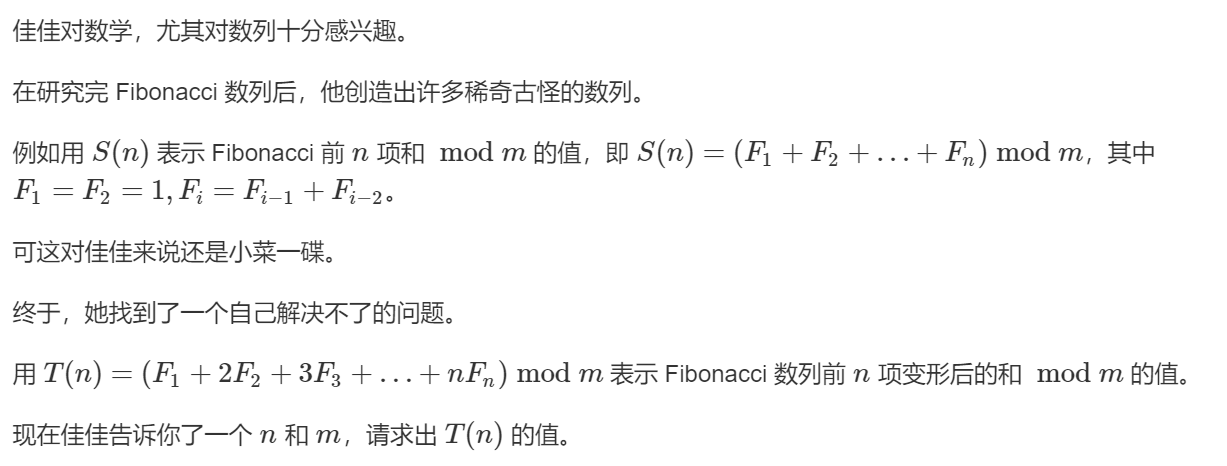
AcWing 1304. 佳佳的斐波那契
PicFailedPlelaseAskMaster

矩阵也很好求

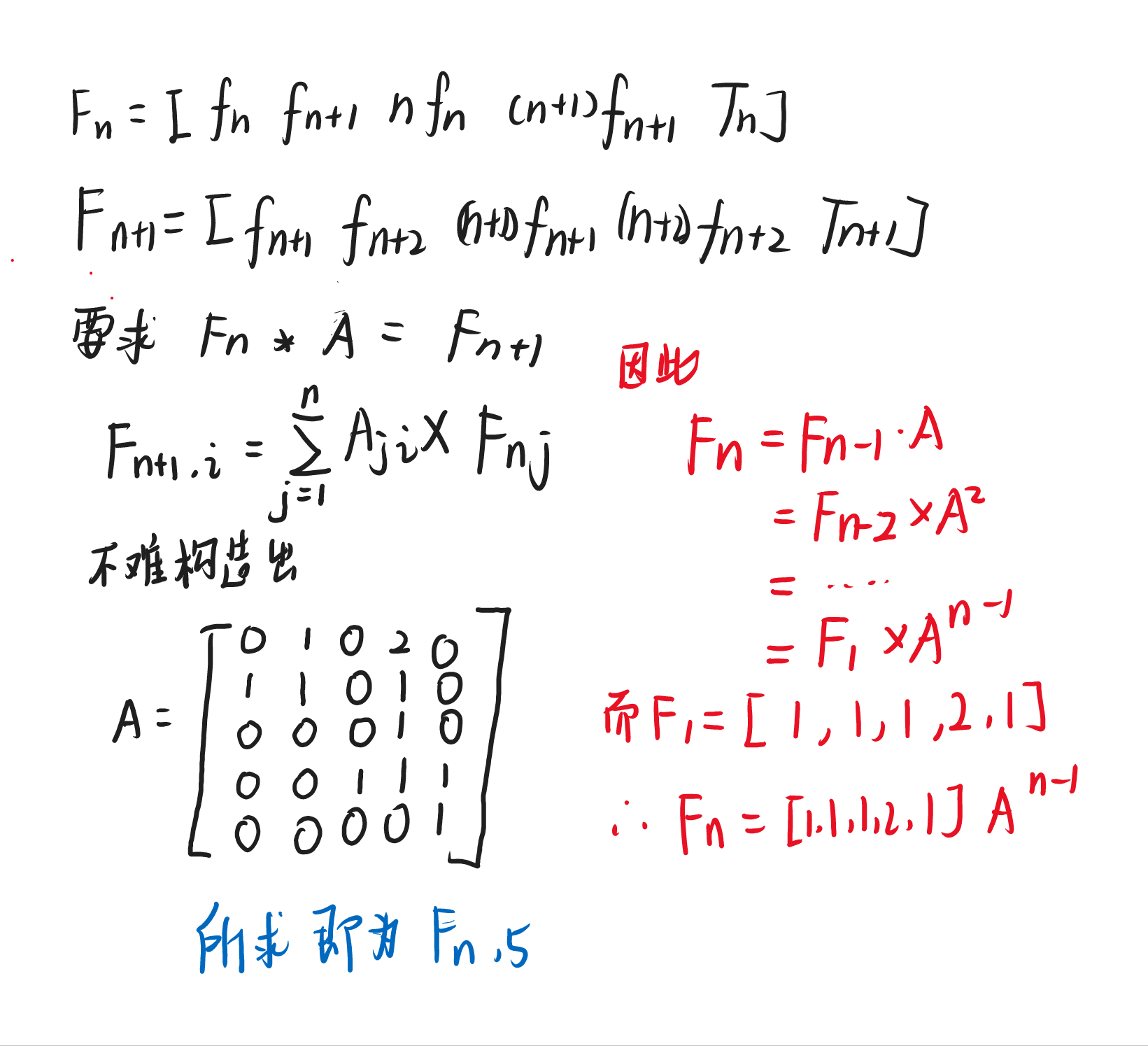
Tn=i=1nifiFn=[fnfn+1nfn(n+1)fn+1Tn]Fn+1=[fn+1fn+2(n+1)fn+1(n+2)fn+2Tn+1]T_n = \sum_{i = 1}^{n} i f_i \\ F_n = \begin{bmatrix}f_n & f_{n + 1} &n f_n & (n+1) f_{n + 1} & T_n\end{bmatrix} \\ F_{n + 1} = \begin{bmatrix}f_{n + 1} & f_{n + 2} & (n + 1) f_{n + 1} & (n + 2) f_{n + 2} & T_{n + 1}\end{bmatrix}

然后设

Fi×A=Fi+1F_i \times A = F_{i + 1}

于是我们有

Fn=F1×An1F_n = F_1 \times A^{n - 1}

A 怎么求?

PicFailedPlelaseAskMaster

1
2
3
4
5
6
7
8
9
10
11
12
13
14
15
16
17
18
19
20
21
22
23
24
25
26
27
28
29
30
31
32
33
34
35
36
37
38
39
40
41
42
43
44
45
46
47
48
49
50
51
52
53
54
55
56
57
58
59
#include <cstdio>
#include <cstring>
#include <iostream>
#include <algorithm>

using namespace std;

typedef long long LL;

const int N = 5;

int n, m;

void mul(int c[], int a[], int b[][N])
{
int temp[N] = {0};
for (int i = 0; i < N; i ++ )
for (int j = 0; j < N; j ++ )
temp[i] = (temp[i] + (LL)a[j] * b[j][i]) % m;

memcpy(c, temp, sizeof temp);
}

void mul(int c[][N], int a[][N], int b[][N])
{
int temp[N][N] = {0};
for (int i = 0; i < N; i ++ )
for (int j = 0; j < N; j ++ )
for (int k = 0; k < N; k ++ )
temp[i][j] = (temp[i][j] + (LL)a[i][k] * b[k][j]) % m;

memcpy(c, temp, sizeof temp);
}

int main()
{
cin >> n >> m;

int f1[N] = {1, 1, 1, 2, 1};
int a[N][N] = {
{0, 1, 0, 2, 0},
{1, 1, 0, 1, 0},
{0, 0, 0, 1, 0},
{0, 0, 1, 1, 1},
{0, 0, 0, 0, 1}
};

n -- ;
while (n)
{
if (n & 1) mul(f1, f1, a); // res = res * a
mul(a, a, a); // a = a * a
n >>= 1;
}

cout << f1[4] << endl;

return 0;
}

欢迎关注我的其它发布渠道